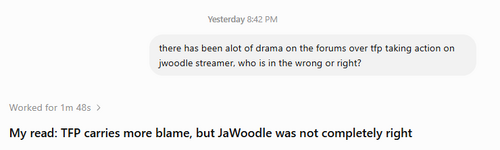
I decided to settle the debate: the verdict by AI is in, AI determined tfp mostly in the wrong
I'm assuming based on how you post here that your AI has been trained to respond disproportionately unfavorably towards TFP.
So here is an unbiased, well informed AI response.
------------
Here is the cleanest way I see the entire situation, based on JaWoodle’s own transcript, the Discord screenshots, the Lurkit terms, the Creator Program requirements, the TFP EULA, and the other timeline evidence you found.
1. TFP/BHVR caused the original problem
BHVR supplied JaWoodle, through the official creator system, with a build presented as Version 3.0 even though it was not the intended Streamer Weekend build. BHVR later acknowledged ambiguity around build access and versioning and accepted responsibility for providing the incorrect build. JaWoodle also says the release notes arrived after he had already completed the videos, although before publication.
When a company distributes prerelease software under embargo, correctly identifying and controlling the build is primarily its responsibility.
2. The EULA strengthens his defense of the initial upload
The 7 Days to Die EULA says that anyone who bought the game or received a gift or press-release copy may monetize video work made with the software. JaWoodle therefore was not merely assuming he could publish gameplay; he had a general written video-monetization license covering press copies. (
Steam Store)
If an official creator build labeled 3.0 appeared in his account, that gives him a legitimate argument that his initial coverage was authorized.
But the EULA does not expressly grant unlimited permission to reveal every hidden asset in every mistakenly supplied internal build. It reserves rights not specifically granted, says special access may require additional terms and policies, treats prerelease copies differently from ordinary copies, and preserves TFP’s ownership of the game’s audiovisual material. (
Steam Store)
So the EULA supports:
“I had general permission to monetize video made from the official press build I received.”
It does not conclusively establish:
“I had unrestricted permission to expose every disabled, unfinished or confidential asset accidentally contained in it.”
The previous NDA is therefore crucial. JaWoodle admits an earlier NDA existed but disputes whether it covered these assets. We have not seen it, so neither side can honestly claim the contractual question is already settled.
3. The first upload was probably not a deliberate leak
Nothing we have shows that he hacked, stole or deliberately sought out the wrong build. It came through the official system and appeared to be 3.0.
However, “I had no way of knowing” goes too far. He says he openly wondered whether the material was “unfinished, hidden, or operating somewhere in the back end.” He also received release notes before publication that apparently did not include the disputed features.
There was also surrounding information indicating Bandits were not part of 3.0, including the developer stream and the instruction to showcase vanilla V3.0. Your contemporaneous messages show that the no-mods rule was being communicated before JaWoodle received the download link.
That does not prove he knowingly leaked anything. It does mean he encountered enough warning signs that stopping to ask would have been the responsible move.
Initial-publication fault: TFP/BHVR 80% — JaWoodle 20%.
4. The real turning point came after he was notified
The first removal request arrived about 14 minutes after publication. He says he was asleep, so there is no fair criticism of him for not responding immediately. When he woke, he pinned a correction, clarified that the features were not in public 3.0, repeated that correction on streams and cancelled planned Instagram posts.
Those actions support his claim that this was not a deliberate leak.
But a correction did not solve the disclosure. The footage remained available for more people to watch, clip, repost and judge. It could continue creating false expectations, expose unfinished work, damage a future reveal and circulate without the pinned explanation.
The screenshots show that TFP/BHVR initially asked him to remove or private the affected videos while they investigated. The later email acknowledged that editing was not a small request and proposed editing the disputed sections from the long-form video while unpublishing the Shorts and TikToks centered on the unreleased material.
JaWoodle instead proposed leaving the videos online with a pinned correction because he was unwilling to absorb the full financial and performance cost of the mistake. That is stated in his own transcript.
His frustration was understandable, but his refusal was still a separate decision.
The EULA does not clearly give TFP automatic editorial control or expressly require deletion on demand. But its general video license also does not guarantee that permission to display mistakenly supplied prerelease content remains unlimited after the rights holder identifies it as unauthorized. The NDA and event-specific terms could control that question.
Morally and practically, once he knew what the footage was, leaving it public because removal would cost him money placed his business interests above containing the disclosure.
Post-notice fault: TFP/BHVR 20% — JaWoodle 80%.
5. Being independent did not mean having no obligations
JaWoodle argues that he was not an employee, was not paid and had not given TFP/BHVR editorial control over his channel. That does not resolve the narrower issue.
TFP did not need ownership of his channel to place conditions on privileged prerelease access. An independent creator can still be bound by an NDA, embargo, limited copyright license or event rules.
The Lurkit terms say Creator Program participants must follow instructions supplied by Lurkit or the participating company concerning Missions and Rewards, and generally bear Mission-related costs unless otherwise agreed. Whether Streamer Weekend legally qualified as a Mission or Reward is unclear, so this is relevant but not decisive.
TFP’s own Creator Program rules mainly support revoking creator status; they do not expressly prohibit debug mode or require takedowns.
6. The escalation was understandable, but severe
After the informal requests and BHVR email failed, JaWoodle received a formal legal demand alleging an NDA breach. He retained counsel, negotiations failed, and TFP submitted copyright takedowns against three videos.
They had a legitimate reason to stop continued distribution of material they regarded as confidential and outside the intended build.
At the same time, copyright strikes are severe. The EULA’s permission to monetize press-copy footage gives JaWoodle a real argument that the initial use was licensed. Whether the takedowns were valid would depend on the actual videos, NDA, scope of the license, fair use or fair dealing, and TFP’s good-faith belief.
The EULA also helps TFP: it gives broad termination rights, allows action where continued access creates risk or potential harm, limits many categories of damages, includes indemnity language and selects Texas law and Texas courts for EULA-related disputes, subject to applicable law. (
Steam Store) That would make a large damages case harder, although it would not automatically defeat independent statutory claims.
A settlement involving reasonable editing compensation, immediate removal, no republication and a mutual release probably would have been the least destructive outcome, although neither side was automatically entitled to those terms.
7. Both public narratives blurred two different events
TFP’s public statement appears to have blurred the time embargo with the permitted scope of coverage. JaWoodle says he published at the stated embargo time, and nothing we have disproves that. TFP should have distinguished publishing early from publishing material outside the intended build.
JaWoodle blurred the events in the opposite direction. The wrong-build mistake strongly defends his initial upload, but it does not justify his later refusal to remove footage after notice.
His strongest argument is:
“I did not intentionally obtain and initially leak prohibited material.”
His weakest is:
“Because they caused the mistake, I was entitled to leave it public unless they absorbed my losses.”
Final fault assessment
This is a moral, ethical and practical judgment—not a court ruling.
Initial supply and publication:
TFP/BHVR 80% — JaWoodle 20%
Conduct after direct notice:
TFP/BHVR 20% — JaWoodle 80%
Legal and public escalation:
TFP/BHVR 45% — JaWoodle 55%
Overall: TFP/BHVR 50% — JaWoodle 50%
TFP/BHVR created the disaster by distributing the wrong prerelease build and communicating poorly. The EULA makes JaWoodle’s initial publication more defensible than it first appeared.
JaWoodle then had a clear opportunity to contain that mistake and knowingly chose not to because removal would cost him money and performance. His correction addressed misinformation, but not the continued disclosure.
TFP/BHVR caused the accident; JaWoodle helped turn it into a prolonged legal and community war by refusing to remove material after he knew it was never intended to be public.


 )
)


 ). But this bit seems either hallucinated or entirely unrelated? Special access .. "special" is only in the EULA in the context of DLC and other online features, and PRE-RELEASE is mentioned only as a complete ban on transferring PRE-RELEASE SOFTWARE. These don't seem related to this case in any way..?